
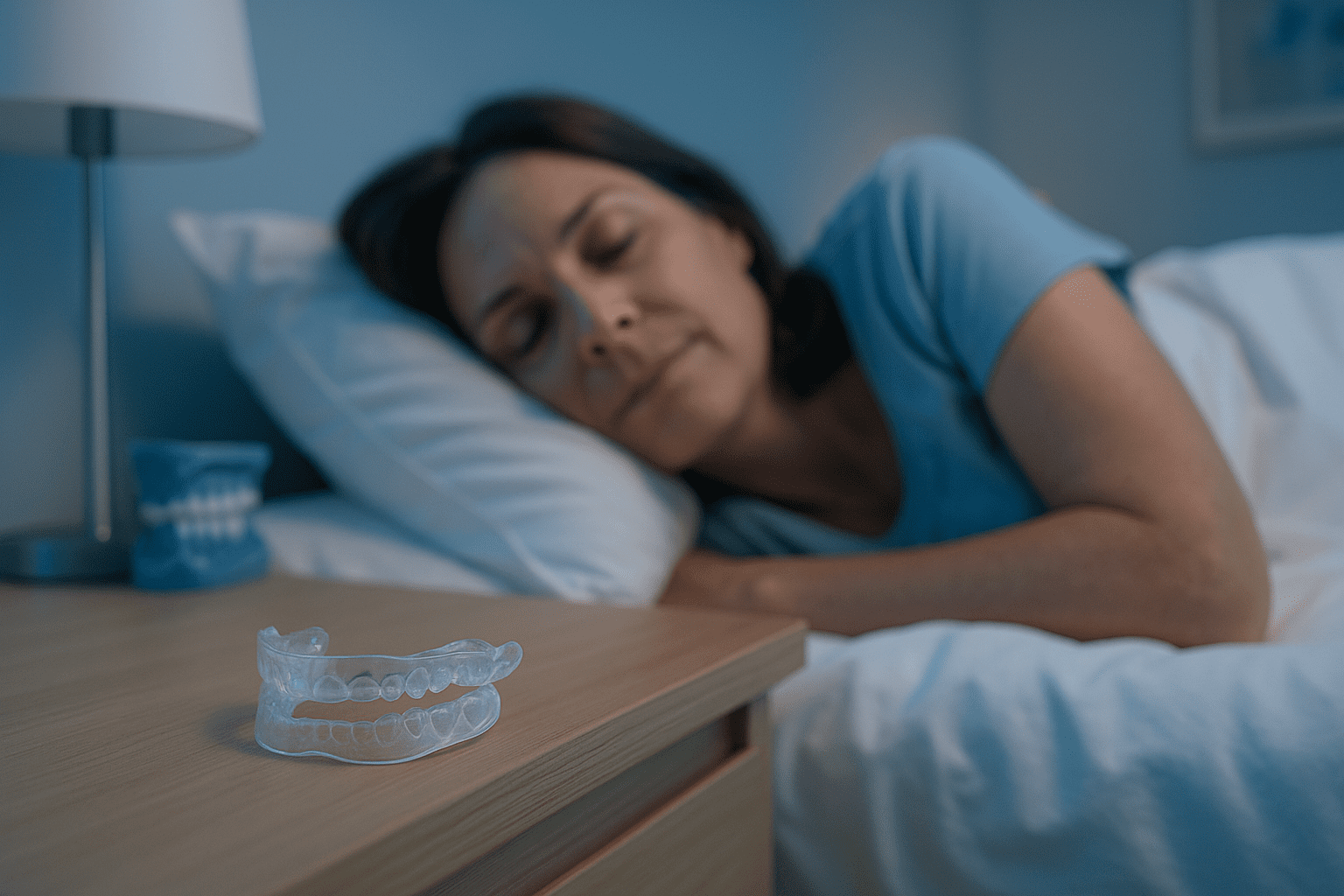
You wear an occlusal splint (night guard) for bruxism, but even with that you snore loudly, wake up exhausted, and your partner notices pauses in your breathing. In some cases, a simple protective night guard is no longer enough: an oral appliance for sleep apnea may become part of your treatment, in collaboration with a sleep physician.
At Dentisterie Montreal, our role is to screen for dental and functional signs, protect your teeth and, when needed, work with your physician to integrate an appliance tailored to your situation.
Sleep apnea: more than just snoring
Obstructive sleep apnea is a breathing disorder in which the airway partially or completely closes repeatedly during the night. These pauses in breathing can happen dozens of times per hour, often without the person being aware of it.
Common symptoms include:
-
Loud, frequent snoring
-
Breathing pauses noticed by a partner
-
Waking up with a feeling of choking or shortness of breath
-
Marked fatigue and sleepiness during the day
-
Morning headaches and difficulty concentrating
The diagnosis of sleep apnea is made by a physician using a sleep study (polysomnography or a home sleep test). Your dentist, however, can detect certain signs, ask the right questions, and refer you to the appropriate professional.
Occlusal splint and sleep apnea: two different roles
An occlusal splint (night guard) is an acrylic, custom-made appliance mainly worn to:
-
protect the teeth against bruxism (clenching or grinding);
-
reduce muscle tension;
-
decrease jaw and temporomandibular joint pain.
Its goal is to protect and make your teeth and jaw joint more comfortable – not to manage your breathing.
A dental appliance for sleep apnea, on the other hand, is designed to:
-
gently move the lower jaw forward during sleep;
-
create more space behind the tongue;
-
help keep the airway more open and reduce snoring and breathing pauses.
In short:
-
The occlusal splint protects your teeth and joints.
-
The mandibular advancement device is aimed at improving your night-time breathing.
That’s why a night guard, even when it fits well, does not treat sleep apnea.
👉 On your website, you can add an internal link to the page
“Le bruxisme et la plaque occlusale” (in the Prevention & Hygiene section) to explain this first aspect to patients.
What is a dental appliance for sleep apnea?
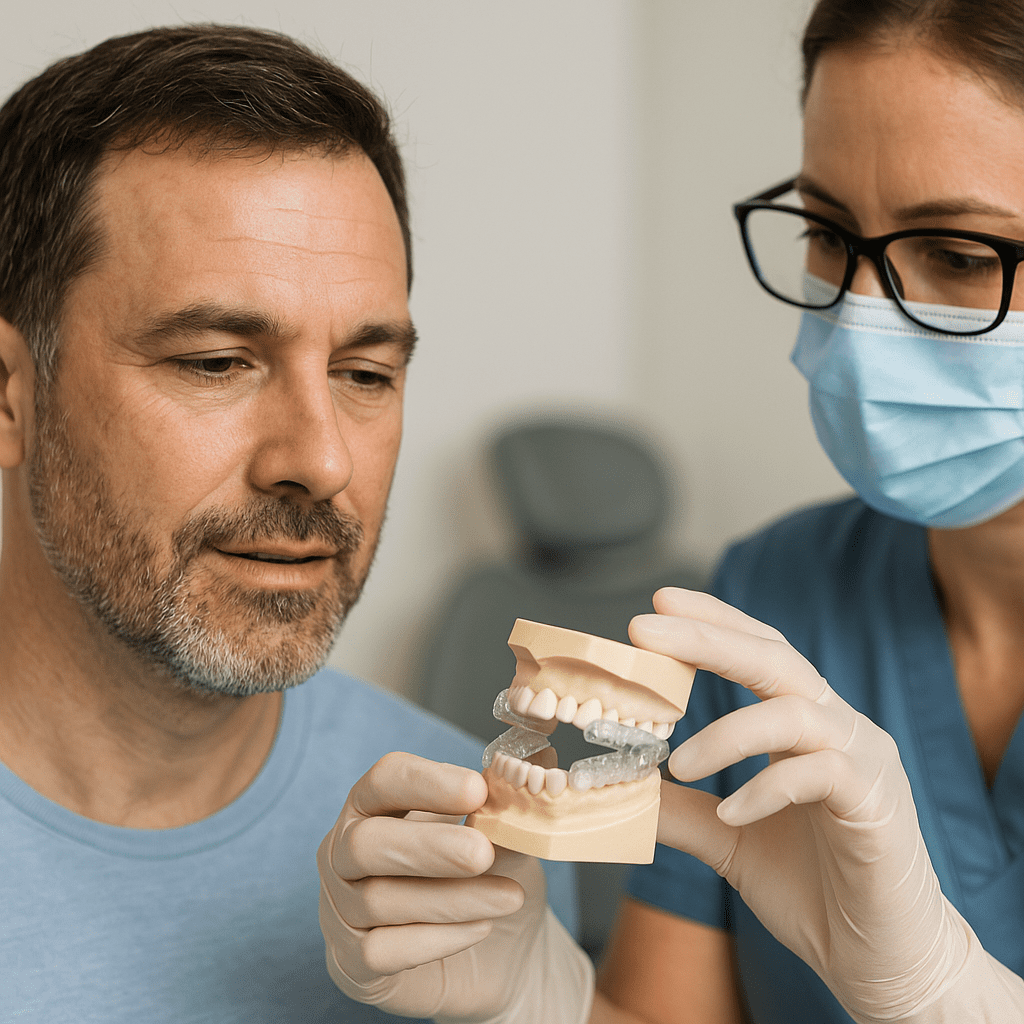
The dental appliance used to help treat sleep apnea is called a mandibular advancement device (MAD). It is usually made of two trays (one for the upper teeth and one for the lower teeth) that hold the lower jaw in a slightly forward position.
This positioning helps to:
-
move the tongue forward;
-
increase the space in the throat;
-
reduce the vibrations that cause snoring;
-
decrease how often the airway becomes blocked.
For search-engine purposes, people sometimes talk about a “sleep apnea dental appliance”, but in reality what really matters is that the device is properly indicated, well fabricated, and closely monitored.
When is this type of appliance recommended?
In general, a mandibular advancement device may be considered:
As a first option
-
for mild to moderate sleep apnea;
-
in patients without major uncontrolled cardiovascular disease.
As an alternative or complementary option
-
for patients who cannot tolerate CPAP;
-
or who are looking for a more discreet and portable solution, with their physician’s approval.
The choice of treatment (CPAP, dental appliance, surgery, lifestyle changes, etc.) is always made with a sleep physician. The role of Dentisterie Montreal is then to design and adjust the appliance according to your needs.
When a night guard is no longer enough: bruxism + sleep apnea
It is entirely possible to:
-
grind or clench your teeth (bruxism);
-
wear an occlusal splint;
-
and also suffer from sleep apnea.
Certain situations should make you stop and think:
-
Your night guard protects your teeth, but you still wake up exhausted.
-
Your partner notices breathing pauses, gasping, or very loud snoring.
-
You have trouble staying awake while driving or at work.
-
You often get up at night to use the washroom or with a racing heart.
In these cases, relying only on the occlusal splint is no longer enough: screening for sleep apnea becomes important.
How does treatment with an oral appliance work at Dentisterie Montreal?
Here is what your journey may look like:
1. Discussion and screening at the clinic
During an appointment at Dentisterie Montreal, your dentist will:
-
ask about your sleep habits, snoring, and level of fatigue;
-
examine your teeth, bite (occlusion), muscles, and jaw joints;
-
assess the presence of bruxism and how effective your current splint is.
If your answers and the exam suggest sleep apnea, a referral to a sleep physician is recommended.
2. Medical diagnosis
The sleep physician will:
-
prescribe a night-time sleep study (in a lab or at home);
-
make the diagnosis and determine how severe it is;
-
discuss treatment options: sleep hygiene, weight loss if needed, CPAP, dental appliance, etc.
3. Designing the dental appliance
If a mandibular advancement device is chosen, you return to the clinic for:
-
a detailed exam of your teeth, bite, and jaw movement;
-
impressions or a digital scan of your teeth to create a custom appliance;
-
explanations on how it works, how to care for it, and possible side effects (sensitivity, temporary discomfort, and so on).
4. Insertion and adjustments
When the appliance is ready:
-
it is tried in your mouth and checked for comfort;
-
the jaw position is gradually adjusted;
-
follow-up visits are scheduled to fine-tune the advancement based on your symptoms and comfort.
5. Joint follow-up with dentist and physician
After a few weeks or months, the physician may recommend another sleep study to confirm how effective the treatment is. At Dentisterie Montreal, we also provide regular follow-up care to:
-
monitor the condition of your teeth and bite;
-
adjust the appliance when needed;
-
make sure it remains comfortable and effective over the long term.
Benefits and limitations of a dental appliance for sleep apnea
Benefits
-
Discreet and portable – easy to travel with.
-
Silent – no machine noise.
-
Often better tolerated than CPAP for some patients.
-
Can significantly reduce snoring and improve quality of life in moderate sleep apnea.
Limitations
-
Less effective than CPAP in severe sleep apnea.
-
Possible jaw or tooth discomfort at the beginning.
-
Over time, without proper follow-up, slight changes in the bite may occur.
This is why regular dental visits and joint medical follow-up are so important.
What about dental sedation?
Some people who need a sleep apnea appliance or a splint for bruxism feel very anxious about seeing a dentist.
Dental sedation options (mild or conscious sedation, depending on your health and the services offered) can:
-
make treatment appointments more comfortable;
-
make impressions or digital scans easier;
-
reduce anxiety related to dental visits.
On your website, you can create or link to a page about sedation and point an internal link to it from this blog post.
When should you talk to your dentist?
It’s time to bring it up if:
-
you already wear a splint for bruxism;
-
you snore frequently and loudly;
-
your partner notices breathing pauses or gasping;
-
you are constantly tired, irritable, or sleepy during the day.
A dental appliance for sleep apnea, custom-made at Dentisterie Montreal and used as part of a medical treatment plan, can make a real difference in your sleep and your overall health.
You feel that your bruxism night guard no longer explains your fatigue?
Book an appointment at Dentisterie Montreal. Our team can screen for signs of sleep apnea, work with your sleep physician and, when appropriate, design a custom oral appliance to help improve the quality of your sleep.

