

Dental Emergency in Montreal: 7 Situations When You Should Call a Dentist Quickly
Severe tooth pain, a broken tooth, swelling or a loose crown? Some situations should not wait. Here is how to recognize a dental emergency, what to do while waiting for your appointment, and when a medical emergency requires 9-1-1 or a hospital instead.
A dental emergency does not always look like a completely broken tooth. A toothache that keeps you awake, a swelling cheek, a persistent bad taste in your mouth or a restoration that comes out can also signal a problem that deserves prompt attention. If you are searching for a dental emergency in Montreal, the most important thing is not to diagnose yourself: call a dental clinic, describe your symptoms and let the team determine how urgent the situation is. At Dentisterie Manoukian, on chemin de la Côte-des-Neiges, our team offers emergency dental care. Depending on the nature and severity of your situation, we can guide you and offer an emergency appointment as soon as possible.
| At a glance: call a dentist promptly if… you have severe or persistent pain, swelling of the gum or face, a possible abscess, a broken or knocked-out tooth, a crown or filling that has come out, unusual bleeding after trauma, or pain that is getting worse after dental treatment. |
When Should You Call 9-1-1 Instead of a Dentist?
Most dental problems should be assessed by a dentist. Some situations, however, become medical emergencies. If you are having difficulty breathing, are in significant distress, have severe facial or jaw trauma, heavy bleeding that will not stop, loss of consciousness, or any other sign that your immediate health is in danger, call 9-1-1 or go to a hospital emergency department. Significant swelling of the face or neck related to a dental infection also deserves special attention, especially if it is progressing quickly or is accompanied by difficulty breathing or swallowing. When in doubt, do not delay urgent medical assessment.
| Important This article provides general information and does not replace a dental or medical examination. If you have serious warning signs, put safety first and seek immediate help. |
1. A Severe or Persistent Toothache
A toothache may feel sharp, constant, throbbing or difficult to tolerate. Severe tooth pain can have several causes, including deep decay, inflammation or infection of the dental pulp, a crack, a damaged filling, trauma, gum disease or an abscess. Only an examination can determine the cause. You should call a dentist promptly if the pain wakes you at night, starts spontaneously without eating or drinking, gets worse when you bite, lingers after hot or cold foods and drinks, or becomes strong enough to interfere with your daily activities. Pain accompanied by swelling, fever or a bad taste in your mouth should be clearly mentioned when you call.
What Can You Do While You Wait?
- Gently rinse your mouth with warm water to help keep the area clean.
- Floss gently if you think food is trapped between two teeth.
- Do not place aspirin directly on the tooth or gum; it can irritate the tissues.
- Avoid chewing on the painful side until you have been assessed.
Depending on the diagnosis, treatment may range from a dental restoration to root canal treatment, an extraction or another procedure suited to the situation.
2. Swelling, an Abscess or Signs of a Dental Infection
A bump on the gum, a swollen cheek, throbbing pain, pus, a bad taste, fever or marked tenderness when chewing can be associated with a dental abscess or another infection.
The Government of Quebec notes that tooth decay that reaches and infects the pulp can cause severe pain, redness, swelling of the gum or cheek, and sometimes fever. An abscess should not simply be watched at home in the hope that it will disappear. Even if the pain temporarily decreases, the source of the problem may still be present. The dentist must determine whether the tooth can be treated, drained, restored, treated endodontically or, in some cases, extracted. Antibiotics do not automatically replace treatment of the dental cause. They may be indicated in certain situations, particularly when the infection shows signs of spreading or causes systemic symptoms, but that decision must be made by a health professional.
| Swelling + difficulty breathing or swallowing If swelling of the face or neck is significant, or if you are having difficulty breathing or swallowing, treat the situation as a medical emergency and get help immediately. |
3. A Broken, Cracked or Significantly Chipped Tooth
A tooth can break after a fall, a blow to the face, biting a very hard food, clenching or grinding, or simply because it was already weakened by a large restoration. A small chip without pain does not always have the same urgency as a deep fracture, but it is still best to have the tooth assessed before the damage gets worse. Call promptly if a large part of the tooth is missing, if you can see a reddish or very sensitive area in the centre of the tooth, if air or cold causes sharp pain, if the tooth is mobile, or if the fracture happened with facial trauma.
What Should You Do?
- Gently rinse your mouth with warm water.
- Apply a cold compress to the outside of the cheek if there is swelling.
- Avoid chewing on the damaged tooth.
- If you find a piece of the tooth, keep it and bring it to the appointment.
Depending on the extent of the fracture, the tooth may sometimes be repaired with composite resin, a ceramic restoration, a crown or root canal treatment. The right solution depends on how much tooth structure remains and the condition of the dental pulp.
4. A Permanent Tooth Knocked Out or Displaced After an Impact
When a permanent tooth is completely knocked out of its socket after an accident, time matters. Call a dentist immediately.
Handle the tooth by the crown, which is the part normally visible in the mouth, and avoid touching the root.
If the tooth is clean and can be put back into place easily without forcing it, the Canadian Dental Association’s first-aid recommendations suggest gently repositioning it. If that is not possible, keep it moist, for example in milk, and get to a dentist quickly. For a baby tooth, do not try to put it back yourself; call a dentist for appropriate instructions instead. A tooth that has not been completely knocked out but has been displaced, pushed inward, pulled outward or suddenly becomes mobile after an impact should also be assessed quickly. If the trauma involves a suspected jaw fracture, loss of consciousness or a significant facial injury, the hospital takes priority.
5. A Crown, Filling or Other Restoration Comes Out
A loose crown, a lost filling or a broken restoration may seem less urgent than an abscess.
However, the exposed tooth can become sensitive, trap food or fracture further. The level of urgency depends on the pain, how much tooth remains and the location of the restoration. Call the clinic and explain what happened. Keep the crown or piece of restoration if you have it. Avoid chewing on the affected side, and do not use household glue to try to reattach the restoration yourself. At Dentisterie Manoukian, restorative dental options include composite resins and ceramics. The clinic also uses CEREC technology for certain ceramic restorations in a single appointment when appropriate. An examination is still necessary to determine which solution is right for you.
6. Unusual Bleeding or a Mouth Injury After Trauma
A fall, sports accident or blow to the face can injure the lip, tongue, gums and teeth at the same time.
A small cut can often be gently cleaned with water and compressed with clean gauze. A cold compress on the outside of the face can help limit swelling. However, heavy bleeding that does not stop despite continuous pressure, a deep wound, a major facial injury or a suspected jaw fracture requires urgent medical assessment. Once the overall medical situation is under control, a dentist can assess the affected teeth. Even without a visibly broken tooth, trauma can damage the dental pulp or the tissues that support the tooth. A tooth that changes colour, becomes painful when chewing or starts to move in the days after an impact should be examined.
7. Pain, Swelling or Bleeding That Gets Worse After Dental Treatment
Some discomfort may be normal after an extraction, surgery or certain dental treatments, depending on the procedure.
What deserves a prompt call is pain that becomes noticeably stronger instead of improving, increasing swelling, fever, a persistent bad taste, concerning bleeding, or any symptom that does not match the instructions you were given. After an extraction, significant pain can sometimes be associated with dry socket when the blood clot protecting the site is displaced or does not remain properly in place. This problem should be assessed by a dentist to relieve the area and check healing. If you recently received care at Dentisterie Manoukian and a symptom concerns you, contact us and describe exactly what you are feeling, how long it has been happening, and whether the situation is improving or getting worse.
What to Expect at an Emergency Dental Appointment in Montreal
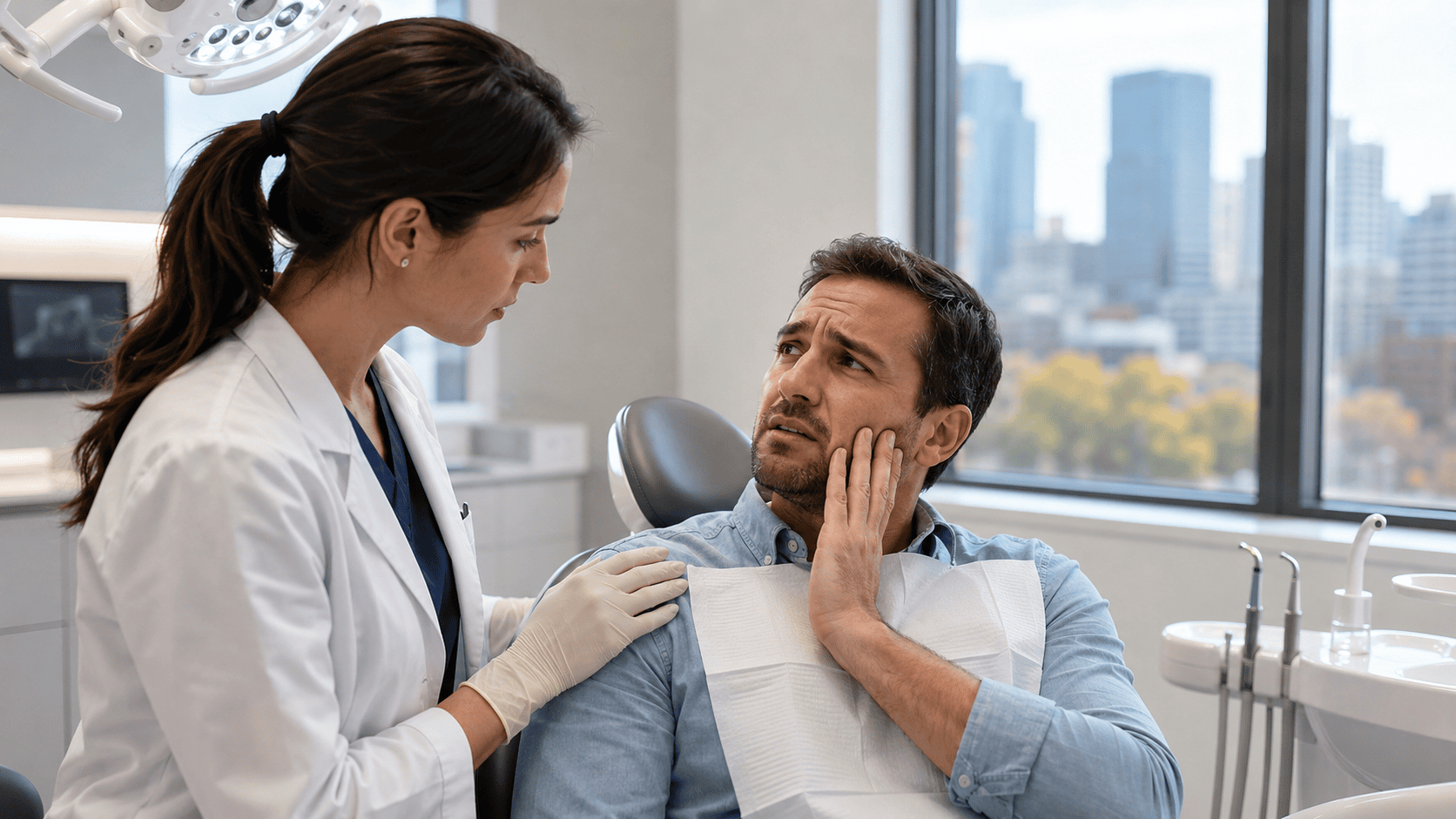
The first goal of an emergency appointment is to understand the source of the problem, relieve pain when possible, and prevent the situation from getting worse.
The assessment may include a focused examination and, when necessary, X-rays or other diagnostic tests. Depending on the diagnosis, the dentist may provide definitive treatment right away or stabilize the situation before a later step. This can include repairing a tooth, placing a temporary or permanent restoration, root canal treatment, managing an infection, an extraction, managing dental trauma, or a referral when specialized care is needed. Are you anxious about receiving dental care? Mention it on the phone and to the dentist. Dentisterie Manoukian offers oral conscious dental sedation for certain patients and procedures after an appropriate assessment. This option is not necessary or indicated for every emergency.
A Montreal Clinic Chosen by Patients Nearby — and Much Farther Away
Dentisterie Manoukian welcomes patients from Montreal as well as the North Shore, including Laval and communities farther north, and Montreal’s South Shore. We also have patients who plan their dental visits with our team from other provinces; some even fly in from cities as far away as Calgary or Vancouver for their dental care. That loyalty means a great deal to us, but an active emergency is not the time to delay care in order to travel. If you are far from Montreal and your situation requires prompt attention, see a dentist or medical service near you. Urgent care should always come before travel.
Frequently Asked Questions About Dental Emergencies
Does a Dental Emergency Always Need to Be Seen the Same Day?
Not necessarily. Some situations can wait until the next available appointment, while others require a much faster assessment. The best approach is to call, explain the pain, swelling, trauma, bleeding or lost restoration, and follow the instructions provided by the team.
Can a Toothache Go Away on Its Own?
The pain may temporarily decrease even though the cause has not been resolved. Deep decay, an inflamed or infected dental pulp, or a crack can continue to progress. Severe or persistent pain therefore deserves a dental assessment.
Are Antibiotics Enough for a Dental Abscess?
Not always. Treating the dental source is often essential. An antibiotic may be indicated for certain infections, particularly when there are systemic signs or evidence that the infection is spreading, but it should be prescribed only when clinically appropriate.
Is a Lost Crown a Dental Emergency?
It depends. If the tooth is painful, very sensitive, broken or exposed, you should call promptly. Even without pain, a loose or lost crown should be assessed to help prevent further damage to the tooth or loss of the restoration.
Can I Go to the Hospital for a Toothache?
For most dental problems without serious medical warning signs, a dentist is the professional best equipped to treat the cause. A hospital becomes the priority when the situation threatens your general health, for example with difficulty breathing, major facial trauma, uncontrolled bleeding or other serious signs.
Need a Dentist for a Dental Emergency in Montreal?
If you have sudden pain, a broken tooth, swelling, a possible abscess, a loose crown or another urgent dental problem, call Dentisterie Manoukian at 514-969-3368. Our clinic is located at 5300 chemin de la Côte-des-Neiges, Suite 300, Montreal, Quebec H3T 1Y3. Depending on your situation and its severity, our team can guide you and offer an emergency appointment as soon as possible. You can also use our Book an Appointment page to send us your request.
| A simple rule Do not wait until pain becomes unbearable. The sooner a dental problem is assessed, the sooner the dentist can determine the cause and discuss appropriate treatment options with you. |

